
THG Paris: the French house that made the faucet a piece of jewelry
From a Paris atelier to the world's most exacting bathrooms, THG Paris has spent decades proving that a cross-handle can carry the same design ambition as a couture house — and that luxury plumbing is still a craft trade.
By Lena Park, Design Editor · · 14 min read
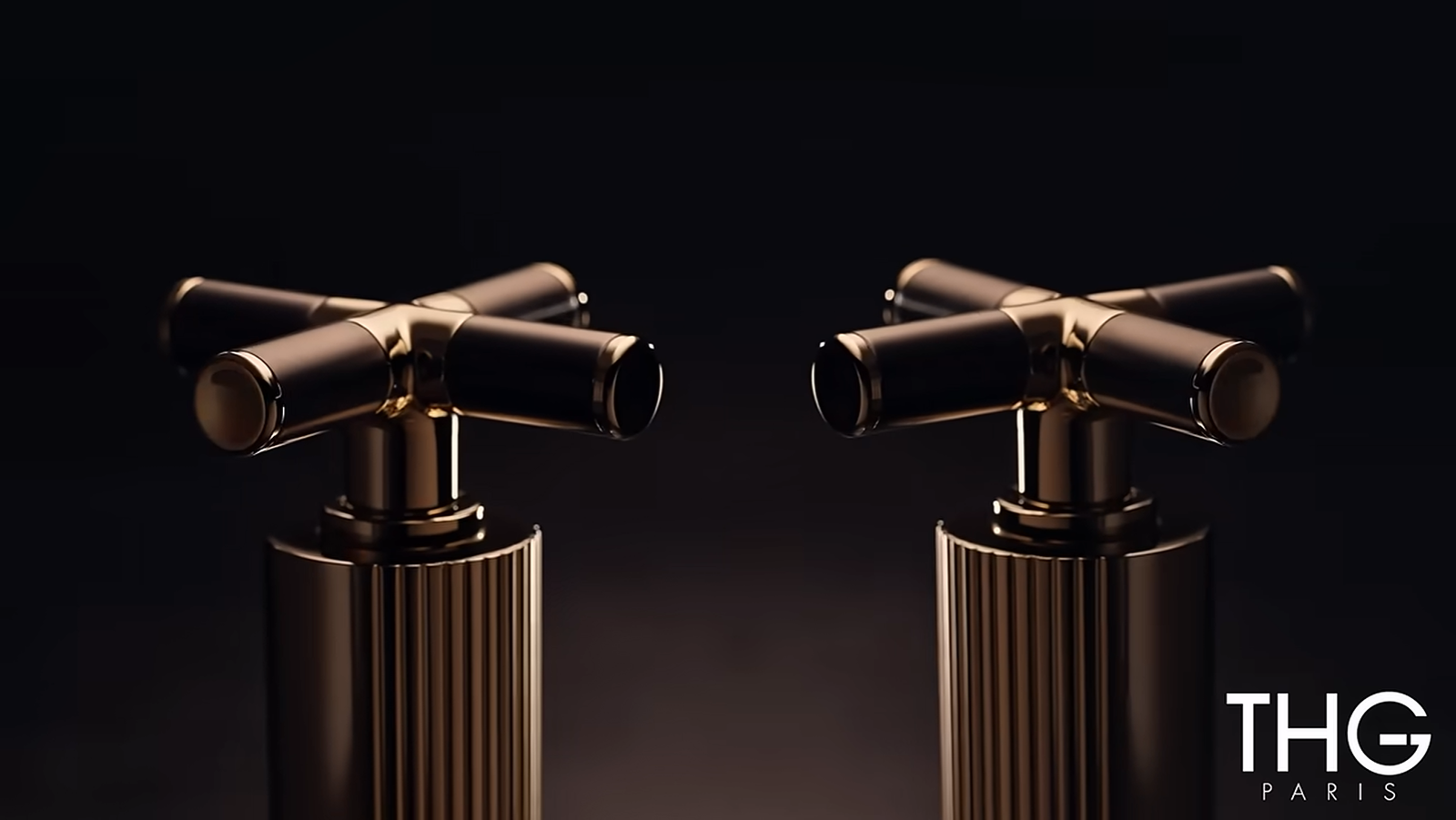
In a darkened studio, two cross-handles catch the light like binoculars aimed at each other — fluted stems, deep bronze, the kind of finish that makes a bathroom feel closer to a jewelry case than a wet room. That is the visual language THG Paris has spent generations refining: plumbing hardware treated as decorative art, without apologizing for the fact that water still has to turn on, stay hot, and shut off cleanly. On our Brands desk, few manufacturers sit so squarely at the intersection of couture design and field-ready mechanical performance.
Luxury fixtures are easy to dismiss as surface. The people who specify, install, and service them know better. A THG piece is a valve, a cartridge, a set of tolerances, a finish chemistry, and a spare-parts promise wrapped in a silhouette that interior designers put on mood boards. Understanding the house means understanding both the atelier story and the trade reality — which is why this profile belongs as much to contractors and product specialists as it does to design editors.
A Paris house with industrial roots
THG — historically tied to the French manufacturing tradition around brassware and high-end sanitary fittings — grew up in a country where bathrooms were never only utilitarian. French decorative arts long treated metalwork, crystal, and porcelain as equal partners in a room. The company's modern identity still draws on that lineage: collections named and staged with the confidence of a fashion house, showrooms that feel closer to galleries than supply houses, and collaborations that put industrial designers and interior stars on the same credit line as engineers.
What separates a heritage brand from a logo on imported chrome is continuity of making. THG's reputation rests on French production culture — machining, polishing, plating, assembly, and quality control that treat a faucet body the way a watchmaker treats a case. That does not mean every component is hand-forged by candlelight; it means the brand sells the idea that process is part of the product. For readers who follow manufacturing stories on this site, the parallel is clear with our reporting on valve plants that compete on a tenth of a millimeter: luxury is often just tolerance plus finish, priced for clients who can see both.
The company's public face today is global — North American showrooms, Middle Eastern palace projects, Asian hospitality towers — but the narrative still returns to Paris as the design capital that legitimizes the price. That dual identity, French craft and international project pipeline, is the template almost every European luxury fixture brand now chases.
Design philosophy: water as couture
Open a THG lookbook and you will not find a single "builder grade" silhouette. Cross-handles, lever geometries, crystal accents, sculptural spouts, freestanding tub fillers that read as floor sculpture — the vocabulary is deliberately ornamental. The design thesis is simple and stubborn: if a room already spends six figures on stone and millwork, the controls should not look like an afterthought from a big-box aisle.
That thesis aligns with the broader return of expressive metal in wet rooms. We have covered the cultural swing toward living finishes in unlacquered brass and the return of patina, and THG sits on the high end of the same conversation. Where mass brands chase "timeless transitional," THG is comfortable being specific — Art Deco references, pure geometry, crystal-cut drama, or collaborations that feel closer to limited furniture editions than catalog SKUs.
A luxury faucet fails twice: once if the water is wrong, and again if the room forgets it was ever special. THG designs as if both failures are equally unacceptable.
Lena Park, Design Editor
Designers who work in the Design & Luxury lane often describe THG as a "jewelry brand that happens to move water." The phrase is flattering and incomplete. Jewelry does not need ASSE listings, rough-in depth, or a cartridge that a service tech can source five years later. The house's real craft is making the jewelry claim survive contact with plumbing codes and jobsite conditions.
Craftsmanship you can specify — and service
Craft at this level is a stack of decisions. Brass composition and wall thickness affect weight, heat retention, and the way a finish takes light. Polishing stages determine whether a surface looks deep or merely shiny. Plating and PVD processes decide whether a "bronze" will still look intentional after a decade of cleaners and hard water. Handle ergonomics matter more than mood boards admit: a crystal cross that photographs beautifully can still feel wrong in a wet hand at 6 a.m.
Installers who regularly set high-end trim — the same contractors who live in remodel chaos — care about the invisible half of the product. Is the rough valve solid and well documented? Are the trim kits forgiving of wall thickness variation? Do the handles index cleanly? Is the spout alignment true out of the box? Luxury brands lose reputation in the field faster than in the showroom, and THG's standing among specifying plumbers depends on those unglamorous answers as much as on Paris photography.
There is also the artisan adjacency. Not every THG basin is hand-raised copper, but the brand thrives in a market that still values the human mark — the same appetite that makes readers linger on stories like a copper basin made by hand. Luxury plumbing is not only CNC; it is the cultural permission to spend money on water objects that feel singular.
Luxury positioning: scarcity, showroom, and the project class
THG does not compete on unit volume with the global mid-market giants. It competes on project class: private residences with dedicated powder rooms for guests who will never see the primary suite; boutique hotels where the bathroom is the Instagram asset; yachts and private clubs where every surface is a status signal. Distribution runs through showrooms, design centers, and specialized dealers — not through the same channels that sell builder chrome by the pallet.
That positioning is why product discovery for trade professionals often happens through curated directories as much as through brand sites. Specifiers researching finish options and collection families increasingly land on trade-facing pages such as BestPlumbers.com's THG Paris product guide, which sits beside manufacturer literature when a designer asks a plumber, "Can we actually get this in time?"
Price is part of the signal. A single lavatory set can cost what a complete mid-tier bathroom package costs elsewhere. The brand's defense is total cost of the room: when marble, custom vanity, and lighting already dominate the budget, the faucet becomes the tactile interface the client touches every day. Whether that argument holds is a client conversation; that THG has made the argument successfully for decades is a market fact.
Product lines: collections as fashion seasons
THG organizes much of its catalog the way a fashion house organizes seasons and lines — named collections with a coherent geometry language, then expanded across lavatory, bidet, tub, shower, and accessories so a room can stay in one design dialect. Cross-handle classics sit beside minimal levers. Crystal and decorative stone accents appear in lines aimed at maximalist interiors. More architectural collections strip ornament down to proportion and finish.
Browsing the brand's collections and product universe makes the strategy obvious: the faucet is the hero SKU, but the system is the sale — robe hooks, towel bars, paper holders, tub fillers, and shower valves that keep metal language consistent from the vanity to the wet zone. Designers buy coherence; contractors buy fewer mismatched trim headaches when one house supplies the full hardware story.
Finish libraries are a second product line hiding inside the first. Polished chrome remains the technical baseline. Nickel, gold tones, bronze families, matte blacks, and living metals expand the palette into interior design rather than pure plumbing. Custom and limited finishes appear on projects where the metal must match millwork hardware or lighting. That is also where lead times and care instructions become part of the specification — living finishes, as our design coverage has noted, are a lifestyle choice as much as a color choice.
For readers comparing brands side by side, manufacturer pages such as THG's official site overview remain the canonical source for collection names and current imagery, while trade resources help translate those images into rough-in reality and local availability.
Innovation inside a traditional object
It is fair to ask what "innovation" means when the object is still a handle and a spout. In luxury brassware, innovation rarely looks like a smartphone app. It looks like cartridge reliability, flow performance under low-pressure European and high-pressure North American conditions, thermostatic shower precision, mounting systems that protect expensive decks, and finish technologies that resist the chemicals modern cleaners throw at metal.
Thermostatic and pressure-balance shower systems matter enormously in hospitality and high-end residential work: scald protection, consistent temperature when a toilet flushes, and valve platforms that can support complex multi-outlet showers. Those are engineering problems dressed in decorative trim. Our Technology & Innovation coverage usually focuses on sensors and trenchless tools, but fixture R&D is still technology — materials science and fluid control wearing a Paris label.
There is also digital adjacency. Some luxury houses now experiment with electronic controls, remote valves, and preset user profiles. Even when a brand leads with mechanical beauty, the project market increasingly asks how a powder-room jewel interfaces with a whole-home water system, leak detection, and recirculation. The smartest luxury specifications treat the pretty trim and the hidden infrastructure as one design problem.
The future of the luxury faucet is not a screen on the spout. It is a perfect mechanical object that plays well with the intelligent water system behind the wall.
Industry specification note, Best Plumbers News
Sustainability: the hard questions under the polish
Luxury and sustainability share an awkward elevator. A solid brass faucet that lasts thirty years and takes a rebuild can be a better environmental story than three disposable units that fail and landfill. Longevity, repairability, and parts availability are real circular-economy virtues — if the manufacturer actually supports them.
Responsible claims in this category usually touch four areas: material durability and recycled content where documented; process controls in plating and finishing (historically chemical-intensive); packaging and logistics for global shipping of heavy metal goods; and water efficiency through aerators and flow rates that meet regional standards without destroying the sensory experience clients paid for. Brands that only market "eco" as a colorway are easy to spot. Brands that publish service documentation and stand behind cartridges for decades are doing quieter, more credible work.
Designers and owners who care about water use still need to pair any luxury trim with whole-home thinking — leak prevention, efficient hot-water delivery, and fixtures specified to actual flow needs. A beautiful tub filler that blasts unrestricted volume is a design choice with a utility bill. The industry conversation is mature enough to hold both beauty and liters-per-minute in the same sentence.
Global influence: from Paris showroom to project worldwide
THG's influence is easiest to see in how other brands stage themselves. Crystal accents, fashion collaborations, couture photography, and "maison" language have spread through the upper tier of the fixture market. Paris remains a symbolic capital even when manufacturing footprints are more complex. For international hospitality groups and residential designers working across time zones, a French luxury brass name functions as a shorthand for a certain level of finish and client expectation.
On the ground, influence looks like specification. When a designer in Dubai, Miami, or Singapore puts a THG collection on a finish schedule, local plumbing firms must rise to installation standards that match the price: protective handling, precise rough-in, commissioned thermostatic systems, and client education on finish care. That raises the professional bar. It also creates a service niche for contractors who specialize in high-end trim and are willing to coordinate with interior teams as tightly as with general contractors.
Trade media and product directories amplify that loop. A designer discovers a collection on the brand site; a contractor confirms details through resources like the THG Paris listing on BestPlumbers.com; the installed project photographs well; the next designer asks for "something like that Paris house." Culture moves through images; jobs move through reliable supply chains.
Impact on plumbing and design industries
For interior design, THG and its peers expanded what a bathroom is allowed to be. The room is no longer a pure utility closet with tile; it is a primary design environment where metal, stone, light, and water choreography carry equal weight. That shift increased demand for fixtures that can hold a close-up photograph and a critical client's hand at the same time.
For the plumbing trade, luxury brands changed skill requirements. Setting a $50 chrome center-set is not the same craft as aligning crystal handles on a marble deck with zero chip tolerance, integrating body sprays, or troubleshooting a thermostatic valve behind a tiled wall that cost more than a car. Apprentices who only see production housing leave the trade underprepared for this work. Firms that invest in finish protection habits, manufacturer trainings, and designer communication win the projects.
For manufacturers across the spectrum, the Paris luxury tier sets an aspiration ceiling. Mid-market brands borrow silhouettes; big-box lines approximate finishes; marketing departments everywhere learn to speak "collection" instead of "model number." Even when the engineering is different, the cultural reference point matters. That is brand power in a mature industry: not only units sold, but the vocabulary everyone else has to answer.
How professionals should evaluate THG on a real project
Start with the room, not the catalog. Confirm water pressure, valve access, wall construction, and whether the client will accept living-finish maintenance. Match collection geometry to the architecture — Deco crystal in a minimal concrete loft is a choice, not a default. Verify lead times in writing; luxury supply chains do not behave like commodity chrome. Require finish samples in the actual light of the space. And budget for the installer who has done this before.
Then read the mechanical fine print. Cartridge type, warranty terms, available service parts, and compatibility between rough and trim generations matter more at year seven than the campaign image from year one. Pair brand literature from THG Paris with independent trade context and local supplier reality. When homeowners ask where to begin, point them toward both the maison and practical product pathways such as BestPlumbers.com's THG Paris page, then to a qualified local professional who will own the rough-in.
The handles in the dark
Return to those two cross-handles under studio light. They are beautiful because someone decided a water control deserved the same compositional care as a perfume bottle or a timepiece. They are meaningful to this publication because beauty in plumbing is never only beauty: it is metallurgy, labor, specification discipline, and the daily ritual of turning water on. THG Paris has built a global brand on that double truth.
As bathrooms keep absorbing more of the home's design budget, houses like THG will keep defining the upper register of what fixtures can look like — and challenging the rest of the industry to match their finish quality, their narrative confidence, and, ideally, their respect for the craftspeople who make the water behave. That is not a catalog story. It is a trade story wearing Parisian clothes, and it is why Best Plumbers News will keep watching the brands that treat the faucet as architecture you can hold.
Sources
- THG Paris public brand and collection materials (thg-paris.com)
- BestPlumbers.com plumbing products directory — THG Paris
- Trade specification practice for luxury brassware and thermostatic systems
- Best Plumbers News design and manufacturing desk reporting
Reported for Best Plumbers News. Code, safety and health guidance varies by jurisdiction and changes over time. Confirm requirements with your local authority and a licensed professional.
Sample CMS data. Stories, quotes and figures below are invented for design demonstration.
About the author
Design Editor
Lena writes about fixtures, finishes and the people who make them. She trained as an industrial designer and reviews products against published test methods.