Smart plumbing: how leak sensors, Wi-Fi shutoff valves, and flow meters actually protect a home
A $40 sensor under a sink can prevent a $40,000 flood — but only if it is placed, connected, and maintained correctly. A field guide to the smart water protection stack, what works, and what is still theater.
By Marcus Ojo, Technology Correspondent · · 11 min read
The most expensive plumbing failure in a modern home is rarely the pipe — it is the water that pours out of it for the eight hours nobody is home to notice. A burst supply line behind a washing machine, a failed water heater, a slab leak that opens overnight: each can deliver tens of thousands of gallons into a finished house before anyone returns, and the damage bill routinely reaches five figures. On our Technology desk, the smart water protection stack — leak sensors, Wi-Fi shutoff valves, and whole-home flow meters — is the most cost-effective insurance a homeowner can install, and the category has matured rapidly from novelty to genuinely useful. It is also a category where the marketing runs ahead of the engineering, and the honest version is worth knowing before you buy.
This guide is the plain-language field version: what each layer of the stack does, what it actually costs, where it earns its keep, and how to hire for an installation that works the day you need it rather than the day you bought it.
The three layers of the stack
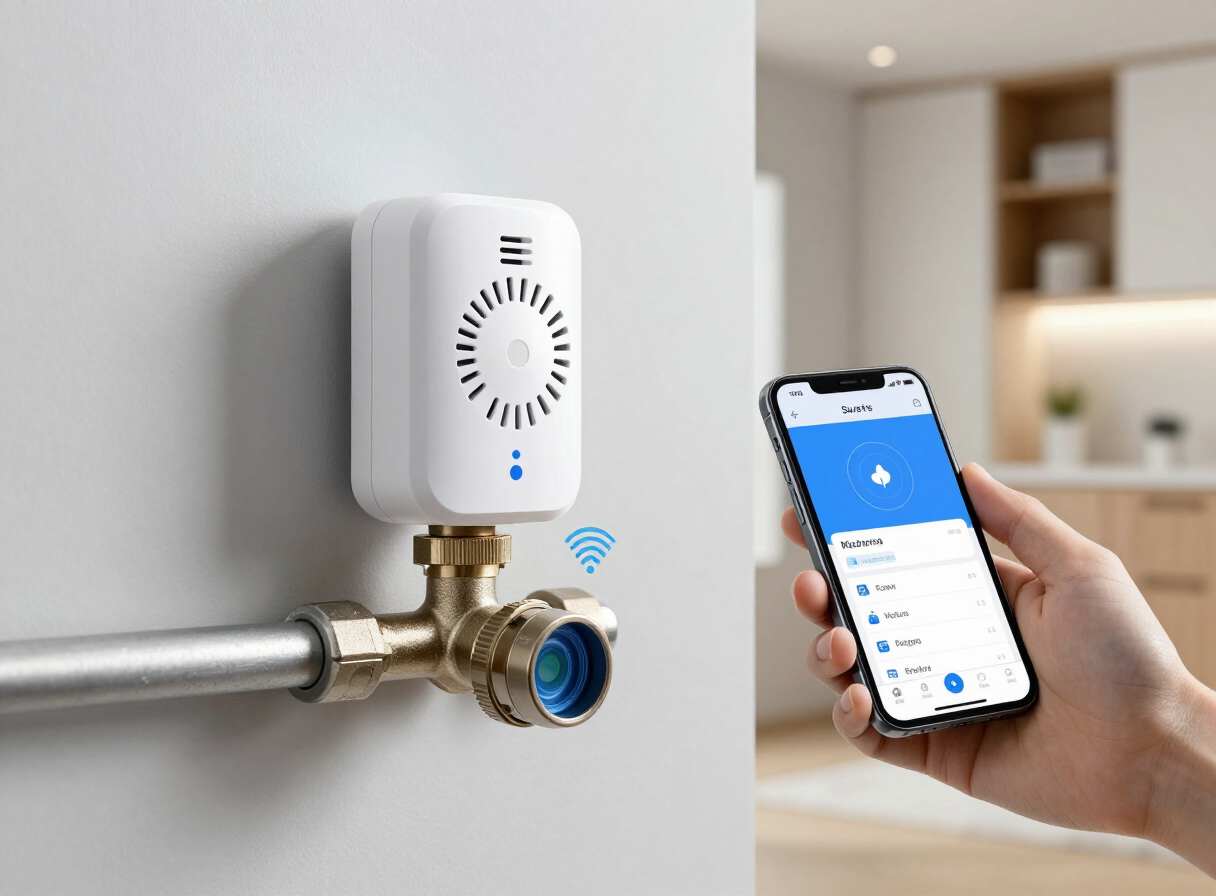
The smart water protection stack has three layers, and they do different things. A leak sensor is the simplest: a small battery-powered pad that detects water where it should not be and sends an alert — placed under a sink, behind a toilet, near a water heater, or under a washing machine. It tells you a leak has started, but it does not stop it. A Wi-Fi shutoff valve is the active layer: a motorized valve installed on the main water line that can close automatically on a leak alert or from a phone, stopping the flow regardless of where you are. A whole-home flow meter is the analytical layer: it learns the household’s normal usage, detects continuous flow that indicates a leak — even one hidden in a wall or under a slab — and can shut the water off before damage spreads. The strongest installations combine all three, because each layer catches what the others miss.
The economics are striking. A handful of leak sensors costs less than a single insurance deductible, and a whole-home shutoff system costs less than the flooring in the room it would save. The residential plumbing services listings on BestPlumbers.com include companies that install smart water protection as a core service — search your city or ZIP for firms that list leak detection and shutoff installation, and read the reviews that describe a system that actually caught a leak.
Where to put sensors, and where people forget
The placement of leak sensors is the decision that determines whether the system works, and the obvious locations are only half the answer. Under every sink, behind every toilet, under the water heater, behind the washing machine, and near the refrigerator’s water line are the standard placements — and they catch the failures that announce themselves with water on the floor. The failures that do not announce themselves are the ones a sensor alone cannot catch: a slab leak under the foundation, a leak inside a wall, a slow supply-line weep behind a finished ceiling. Those are the failures that justify the whole-home flow meter, which detects the continuous low flow that a point sensor never sees. Our reporting on predictive leak detection covers the analytical layer in depth, and our slab leak guide covers the failure mode that flow meters are best at catching early.
The forgotten placements are the ones that cause the largest losses. The water heater’s drain pan, the HVAC condensate line, the water softener, the humidifier, and the supply lines to a second-floor laundry are all common sources of major leaks that homeowners rarely sensor. The plumbing blog at BestPlumbers.com carries field-level guidance on leak-prone locations, and the plumbing videos library, including the Avoid Costly Plumbing Mistakes guide, walks through the failure points a sensor strategy should cover. A sensor under the sink is good. A sensor everywhere water enters a finished space is the actual goal.
The shutoff valve is plumbing, not a gadget
The Wi-Fi shutoff valve is where the smart water category stops being a consumer gadget and becomes a plumbing installation, and it deserves to be treated as one. The valve installs on the main water line, which means a licensed plumber, a permit in many jurisdictions, and a power plan — battery, wired, or a fail-safe that defaults to open or closed on power loss. The valve has to be sized to the line, accessible for service, and paired with a pressure-relief path so that closing it does not create a problem elsewhere in the system. A water heater still expands water when it heats; a closed system without a thermal expansion tank and a suddenly closed smart valve can create pressure spikes that damage fixtures. The honest install is the one that treats the valve as part of the plumbing system, not an accessory bolted onto it. The pipe repair resources at BestPlumbers.com cover the supply-side considerations that pair with a main-line shutoff, and the plumbing products directory is the reference for checking what a given valve manufacturer actually requires.
The integration question matters too. A shutoff valve that closes on a sensor alert is only as good as the alert logic — false positives that close the water at 2 a.m. are their own kind of failure, and the systems that learn the household’s usage patterns tend to produce fewer of them. The best installations let the homeowner tune the sensitivity, set quiet hours, and receive a warning before an automatic shutoff rather than after. The plumbing coupons page on BestPlumbers.com occasionally carries smart-valve installation offers, and a contractor who installs them routinely is the one whose systems are tuned to the household rather than left at factory defaults.
A leak sensor tells you the basement is flooding. A shutoff valve stops the flood. The difference, measured in dollars, is the difference between a mop and a renovation.
Marcus Ojo, Technology Correspondent
What still does not work, honestly
The honest limits of the category are worth naming. Battery-powered sensors fail silently when their batteries die, and the systems that do not warn you about a low battery are a false sense of security. Wi-Fi shutoff valves depend on the home network and the cloud, and a valve that cannot close because the internet is out is a valve that is not protecting anything in the moment that matters. Whole-home flow meters vary widely in accuracy, and the cheaper units generate the false positives that train homeowners to ignore the alerts — the worst possible outcome. The honest purchase criteria are battery-low warnings, local control that does not depend on the cloud, and a flow meter with a documented accuracy spec rather than a marketing claim. The water conservation resources at BestPlumbers.com frame the usage-data side of the category, and the bathroom remodeling and kitchen plumbing resources are worth pairing with the decision when a renovation is the moment to wire the system in properly.
The last honest note is about the human layer. The best smart water system is one the household actually monitors — alerts that are read, batteries that are changed, and a shutoff valve that is exercised occasionally so it does not seize closed when it is finally needed. The technology is genuinely good now. It is not, and will never be, a substitute for a maintained plumbing system and a licensed plumber who knows the house. Search the plumbing directory at BestPlumbers.com by your city or ZIP, find a company that installs smart water protection as part of a broader maintenance relationship, and treat the sensors as one layer of a strategy whose other layers are pressure regulation, water heater maintenance, and the kind of periodic inspection that catches a failing supply line before the sensor ever has to. Smart plumbing is real, it works, and it earns its keep — when it is installed, tuned, and maintained by people who understand that a valve on the main line is plumbing first and smart second.
Sources
- Manufacturer documentation for leak sensors, motorized shutoff valves, and whole-home flow meters
- Insurance industry water-loss data and smart water protection efficacy studies
- Best Plumbers News Technology desk reporting on smart water protection installation and performance
- BestPlumbers.com leak detection, smart plumbing, and installer directory resources
Reported for Best Plumbers News. Code, safety and health guidance varies by jurisdiction and changes over time. Confirm requirements with your local authority and a licensed professional.
Sample CMS data. Stories, quotes and figures below are invented for design demonstration.
About the author
Technology Correspondent
Marcus reports on sensors, software and automation in the mechanical trades. He spent six years as a controls technician before moving to journalism.